
A child spends several minutes arranging toy cars in a line. The next day, the same child builds a road using wooden blocks. Later, during outdoor play, they stop to watch a delivery truck.
Are these unrelated moments, or could they reveal a developing interest in vehicles, movement, and how things work?
For parents and early childhood educators, everyday play provides valuable opportunities to understand what captures a child’s curiosity.
To identify a child’s interests, observe what they choose voluntarily, return to repeatedly, ask questions about, and explore in different ways. Look for patterns across activities and settings rather than drawing conclusions from a single moment.
The goal is not to label children or predict their future abilities. It is to understand their emerging interests and use those observations to create meaningful learning opportunities.
Why Observing Children’s Play Matters
Children do not always communicate their interests through direct statements.
A preschooler might tell an educator that they love dinosaurs. A toddler may express curiosity by repeatedly opening and closing containers. An infant might show interest through reaching, looking, vocalising, or responding to familiar sounds.
Each behaviour can offer clues about what a child finds engaging.
According to the National Association for the Education of Young Children (NAEYC), intentional observation helps educators understand children’s individual strengths, interests, experiences, and development.
Observations can also inform decisions about learning environments, materials, and teaching strategies.
In Ontario, the How Does Learning Happen? pedagogical framework encourages educators to view children as capable, curious learners and to support exploration, play, and inquiry.
Identifying interests is therefore not about collecting as much information as possible. It is about noticing meaningful details and responding thoughtfully.
Six Signs That May Reveal a Child’s Interests
No single behaviour proves that a child has a particular interest. However, several patterns can help parents and educators understand what a child is choosing to investigate.
1. Repeatedly Choosing the Same Activity
One useful clue is repetition.
A child might return to puzzles, construction materials, pretend cooking, or musical instruments across several play opportunities.
Repeated choices can suggest that an activity is meaningful or enjoyable.
For example, a child who frequently selects building blocks may be interested in construction, balance, shapes, or the process of combining objects.
The important question is not simply which toy the child chooses, but what they do with it and why they might be returning to it.
2. Exploring an Activity in Different Ways
Children sometimes demonstrate curiosity by experimenting with familiar materials.
A child interested in water might begin by pouring it between containers, then investigate floating objects, compare quantities, or notice what happens when water moves across different surfaces.
The interest may be broader than the material itself.
The child could be exploring movement, cause and effect, volume, or sensory experiences.
Educators can discover more by observing how the activity changes over time.
3. Asking Questions or Making Observations
Questions are another valuable source of information.
A preschooler might ask:
- Why does the moon appear at night?
- How do bridges stay standing?
- Where do birds go when it rains?
- Why does this object float?
These questions can reveal subjects the child wants to understand.
Younger children or children who communicate differently may express similar curiosity through pointing, gestures, expressions, or repeated actions.
Observation should account for different forms of communication rather than relying entirely on spoken language.
4. Returning to a Challenge
Some children repeatedly experiment with a problem, such as balancing objects or assembling a structure.
A child might build a tower, watch it fall, and then try using a wider base.
This behaviour may indicate curiosity about how the structure works.
However, persistence is only one possible clue. A child who changes activities quickly may still have meaningful interests that are expressed differently.
5. Bringing the Same Theme Into Different Activities
An emerging interest may appear across several contexts.
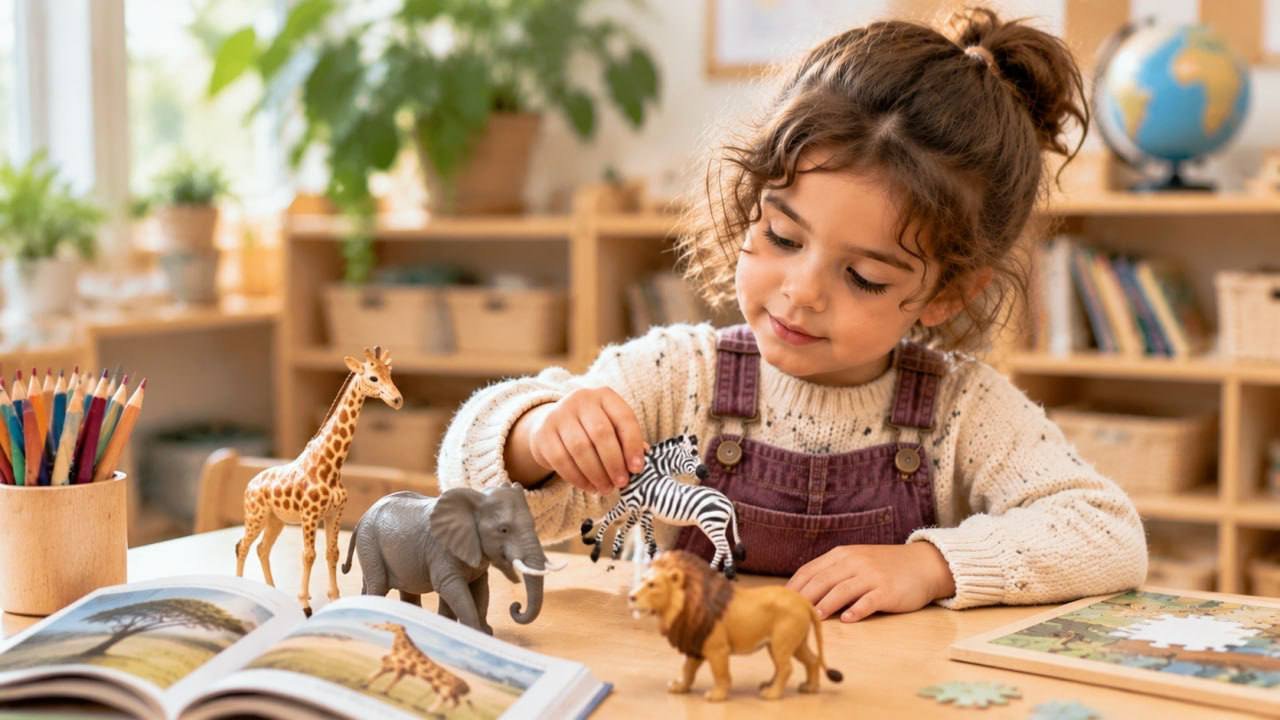
For example, a child interested in animals may:
- Choose animal figures during free play.
- Ask for animal stories.
- Imitate animal movements.
- Draw pictures of pets or wildlife.
- Talk about an animal they noticed outdoors.
When similar themes appear in different situations, they provide a stronger basis for planning new experiences than one isolated choice.
6. Inviting Others Into Their Discoveries
Children may also reveal interests through social interaction.
A child might invite an educator to examine a construction project, show a parent a newly discovered insect, or explain the story behind a drawing.
These moments can provide opportunities for meaningful conversation.
Harvard University’s Center on the Developing Child describes the importance of responsive, back-and-forth interactions between children and caring adults through the concept of serve and return.
Following a child’s attention and responding supportively can enrich everyday interactions without turning play into a formal lesson.
How to Identify a Child’s Interests: A Six-Step Observation Method
Parents and educators can use a simple observation process without specialised equipment.
Step 1: Begin with Ordinary Play
Choose familiar situations in which the child has opportunities to make decisions.
These may include:
- Indoor free play.
- Outdoor exploration.
- Pretend play.
- Art and creative activities.
- Reading and storytelling.
- Music and movement.
- Everyday routines.
Avoid introducing too many instructions or questions at the beginning.
Give the child room to choose an activity and interact with available materials.
The purpose is to see what naturally captures their attention.
Step 2: Record What Actually Happens
An observation should describe what the child did rather than immediately interpreting their personality or abilities.
For example:
Less useful observation:
“Emma is very intelligent and loves mathematics.”
More useful observation:
“During block play, Emma arranged six wooden pieces from shortest to tallest and repeated the activity using different blocks.”
The second statement provides specific, observable information that educators can revisit and discuss.
It does not assume a fixed talent or developmental level.
Step 3: Look for Patterns Over Time
One activity is not enough to define an interest.
A child may select an object because it is new, because a friend is using it, or because other materials are unavailable.
Look for recurring themes over several opportunities, ideally across different contexts.
Ask:
- Does the child return to this subject?
- Do they choose related activities independently?
- Do they explore new aspects of the same topic?
- Does the interest appear at home, in childcare, or outdoors?
An emerging pattern is a reason to explore further, not a reason to assign a permanent label.
Step 4: Ask Open-Ended Questions
When appropriate, use gentle questions that allow children to express their own ideas.
For example:
- “What are you making?”
- “What do you notice?”
- “What would you like to try next?”
- “How did you decide to do that?”
- “What happened when you changed it?”
Avoid turning every activity into a series of questions.
Children also need time to concentrate, experiment, and play without interruption.
For children who communicate nonverbally, an adult can acknowledge a gesture, offer a choice, or describe an action instead of expecting a spoken answer.
Step 5: Compare Observations with Families and Educators
Children may show different interests in different environments.
A child who prefers quiet drawing at childcare might enjoy energetic outdoor play at home.
Sharing brief observations can help adults build a more complete picture.
For example, an educator might tell a parent:
“Today, Maya spent time arranging leaves by shape and comparing their colours. Has she been interested in collecting natural objects at home?”
This approach invites collaboration without making assumptions about the child’s abilities.
Step 6: Offer a New Opportunity and Observe Again
Once an interest appears, introduce an activity that extends it.
If a child enjoys toy cars, offer a ramp and invite them to explore how different vehicles move.
If the child is interested in birds, provide illustrated books, drawing materials, or opportunities to observe birds outdoors.
Then observe what happens.
Does the child engage with the new materials? Do they introduce a new question? Does the original interest change?
Interest identification should be an ongoing process of observe, reflect, respond, and observe again.
A Simple Child Interest Observation Checklist
A short record can make observations more useful without adding unnecessary administrative work.
| What to Record | Guiding Question |
|---|---|
| Date and setting | When and where did the activity occur? |
| Materials selected | What did the child choose? |
| Observable actions | What did the child actually do? |
| Communication | What did the child say, gesture, or show? |
| Possible interest | What topic or process might be attracting attention? |
| Next opportunity | What related experience could be offered? |
Example of a Completed Observation
Child: Preschool-aged learner (illustrative example)
Setting: Indoor free play
Activity: Wooden blocks and toy vehicles
Observation: The child placed wooden blocks in two parallel lines and moved toy cars between them. After one car became stuck, the child moved the blocks farther apart and repeated the activity.
Possible interest: Vehicles, spatial relationships, construction, or testing how objects move through spaces.
Suggested follow-up: Introduce ramps, cardboard roads, and vehicles of different sizes.
What to observe next: Whether the child compares widths, changes the layout, invents a story, or explores another aspect of movement.
This format helps distinguish an observation from an interpretation.
It also keeps the follow-up flexible rather than treating the educator’s initial hypothesis as a confirmed fact.
Three Everyday Play Examples That Reveal Children’s Interests
Example 1: Exploring Movement with Toy Vehicles
What the child does: Repeatedly rolls cars down a sloping surface and changes the position of the ramp.
What an educator might notice: The child appears interested in movement, speed, or how the height of a ramp changes what happens.
Possible next activities:
- Try ramps of different heights.
- Compare vehicles of different sizes.
- Use words such as faster, slower, higher, and lower.
- Encourage the child to describe what they notice.
Potential learning opportunities: Early scientific inquiry, spatial reasoning, comparison, and communication.
The educator does not need to formally teach physics. The activity can remain exploratory and enjoyable.
Example 2: Discovering Patterns Through Art
What the child does: Repeatedly creates circles and lines, arranging them in similar patterns across different drawings.
What an educator might notice: The child could be exploring repetition, shape, movement, or visual design.
Possible next activities:
- Offer different drawing surfaces.
- Introduce stamping materials.
- Explore patterns with large blocks or other age-appropriate objects.
- Invite the child to describe their creation.
Potential learning opportunities: Creative expression, pattern recognition, fine motor coordination, and language.
Avoid assuming that a child has a specific artistic talent because they repeatedly choose drawing.
The value lies in understanding what the child enjoys exploring.
Example 3: Investigating Water During Sensory Play
What the child does: Transfers water between containers and repeatedly tests which objects float or sink.
What an educator might notice: The child may be interested in cause and effect, properties of materials, or sensory exploration.
Possible next activities:
- Offer containers of different shapes.
- Compare a small selection of safe floating and sinking objects.
- Encourage simple predictions.
- Discuss what changes and what stays the same.
Potential learning opportunities: Observation, comparison, early scientific vocabulary, and problem-solving.
Water play requires close, active adult supervision and an environment appropriate for the child’s age and abilities. Water should never be left accessible to young children without supervision.
How Interests May Look Different Across Ages
Children’s interests can be expressed differently depending on their development, communication, and available experiences.
Infants
An infant’s curiosity may appear through looking, reaching, turning toward sounds, moving, or responding to a familiar interaction.
Adults can observe what attracts attention and respond through shared play, facial expressions, sounds, and conversation.
The purpose is not to categorise an infant’s future preferences, but to build responsive relationships and offer safe exploration.
Toddlers
Toddlers may repeatedly explore actions such as filling, emptying, stacking, pushing, pulling, and transporting objects.
These repeated behaviours may be valuable clues about the experiences they enjoy investigating.
Educators can introduce variations while respecting the toddler’s need for repetition and discovery.
Preschool-Aged Children
Preschoolers may express interests through increasingly elaborate pretend play, drawings, construction projects, conversations, stories, and questions.
They may combine several interests or develop a shared project with peers.
However, age categories are only general guides. Individual development varies, and interests should not be judged against a rigid timetable.
Five Common Mistakes When Identifying Children’s Interests
1. Assuming One Activity Defines a Child
A child who chooses puzzles once should not automatically be described as a puzzle enthusiast.
Observe additional experiences before drawing conclusions.
2. Confusing Interest with Ability
A child can love music without demonstrating advanced musical skills.
Likewise, a child may possess a skill without choosing to practise it during free play.
Interests and abilities are related concepts, but they are not interchangeable.
3. Offering Only Familiar Activities
If children are exposed to only a limited selection of materials, their choices may reflect what is available rather than the full range of their interests.
Introduce new, accessible, developmentally appropriate experiences alongside familiar favourites.
4. Overlooking Quiet or Nonverbal Engagement
Some children communicate through gestures, movement, facial expressions, or focused exploration rather than frequent speech.
Observation methods should allow different ways of participating and expressing curiosity.
5. Turning Observations into Fixed Profiles
Descriptions such as “a science child” or “not interested in reading” can unnecessarily restrict expectations.
Use flexible language such as “currently interested in building” or “has recently been exploring musical patterns.”
These descriptions leave room for change and new experiences.
How Can Educators Use Observations to Plan Activities?
Observations become valuable when they inform thoughtful decisions.
An educator might notice that several children have recently shown curiosity about gardening.
Instead of immediately creating a rigid project, the educator could offer opportunities to explore seeds, soil, leaves, plant shapes, and illustrated books.
Individual children may approach the topic differently.
One might enjoy sorting seeds. Another may prefer drawing plants. A third might focus on watering and caring for them.
A responsive plan offers different ways to participate while supporting shared learning goals.
Ontario’s How Does Learning Happen? framework describes pedagogical documentation as more than recording events. It is a process that helps educators interpret children’s experiences and reflect on their learning.
The aim is not to document everything. It is to gather information that supports better interactions, environments, and educational decisions.
Using Digital Tools Responsibly
Digital tools can provide ways to organise observation notes, revisit activity records, and support communication between educators and families.
However, collecting more data does not necessarily produce a better understanding of a child.
Useful documentation should be accurate, relevant, limited to an appropriate purpose, and interpreted within the child’s broader context.
When recording children’s activities, childcare providers should consider privacy, access controls, information retention, and appropriate parental or guardian consent.
The Office of the Privacy Commissioner of Canada provides guidance on meaningful consent, including additional considerations for children’s personal information.
A digital activity record should not be used to assign fixed labels, make unsupported developmental predictions, or replace qualified professional assessment.
How GAB Tech Connects with Interest-Based Learning
GAB Tech’s vision brings together children’s activity information, interest-based learning, and communication between families and childcare settings.
The company presents technology as a potential way to make information about children’s experiences more organised and useful for activity planning.
The educational principle remains human-centred: observations should help parents and educators respond to individual curiosity, not replace their knowledge of the child.
Learn more about GAB Tech’s approach to childcare challenges, its proposed solution, and the technology behind its concept.
Conclusion: Start by Watching What Children Choose
Identifying children’s interests does not require complicated tests or expensive learning materials.
It begins with paying attention.
Notice which activities children choose, what they return to, how they experiment, and what they communicate through words, actions, or gestures.
Record meaningful observations, look for patterns over time, and offer opportunities that help children explore further.
Above all, remain open to change. Children’s interests are not permanent categories. They are evolving expressions of curiosity shaped by experiences, relationships, and environments.
When educators and families use observations thoughtfully, everyday play can become a valuable starting point for meaningful learning.
To explore how GAB Tech approaches interest-based learning and childcare innovation, visit GAB Technology or contact the team.
Frequently Asked Questions
How can I identify my child’s interests at home?
Watch what your child chooses during free play, which subjects they return to, and what they ask questions about. Look for recurring themes across different situations and introduce related activities to explore their curiosity further.
How long should educators observe a child before identifying an interest?
There is no universal observation period. The goal is to collect enough contextual information across different opportunities to identify a meaningful pattern. Observations should be revisited as the child’s interests change.
What if a child changes interests frequently?
Changing interests is not necessarily a concern. Young children explore many different experiences, and their preferences may change with new opportunities, environments, and relationships. Offer varied materials and avoid permanent labels.
Can child observation identify developmental delays?
Informal observations can help educators notice questions or concerns worth discussing with families and qualified professionals. They do not establish a diagnosis and should not replace validated developmental screening or professional assessment.
Can technology identify a child’s interests automatically?
Digital systems may organise recorded activities or suggest patterns, but their conclusions depend on data quality, system design, and appropriate interpretation. Automated outputs should not be treated as definitive descriptions of a child. Educator and family judgement remains essential.
External research and professional sources
NAEYC — Using Observation to Guide Your Teaching (2022)
https://www.naeyc.org/resources/pubs/tyc/fall2022/observation-guides-teaching/
NAEYC — Bringing Observation and Documentation to Life in Infant and Toddler Settings (2023)
https://www.naeyc.org/resources/pubs/yc/spring2023/rocking-and-rolling
Ontario Ministry of Education — How Does Learning Happen? Ontario’s Pedagogy for the Early Years
https://www.ontario.ca/page/how-does-learning-happen-ontarios-pedagogy-early-years
Harvard Center on the Developing Child — Serve and Return
https://developingchild.harvard.edu/key-concept/serve-and-return/
Office of the Privacy Commissioner of Canada — Guidelines for Obtaining Meaningful Consent
https://www.priv.gc.ca/en/privacy-topics/privacy-for-businesses/appropriate-handling-of-personal-information/collecting-personal-information-and-consent/consent/gl_omc_201805/